Structural Drying and Dehumidification in Redmond, WA
Surfaces dry fast; framing, subfloor and wall cavities do not. The drying team sets equipment for the class of loss and keeps it running until readings reach the IICRC S500 drying goal.
(888) 509-1696Get the Redmond drying set up now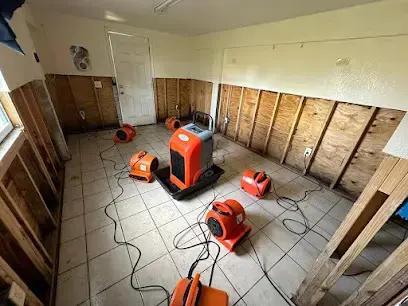
What to do when the house is wet after a leak in Redmond
- Stop the water source Drying cannot start while water is still coming in.
- Get standing water out Extraction first; dehumidifiers cannot keep up with puddles.
- Keep the heat on A warm house dries faster than a cold one.
- Leave equipment running Turning air movers off overnight stalls the drying.
What does structural drying and dehumidification cost in Redmond, WA?
In Redmond, WA, structural drying typically runs $1,000 to $6,000 for a residential loss. The drivers are the class of loss, the square footage, the materials (hardwood and plaster take longest) and how many days the equipment runs.
Class 1 or 2, one area
- Air movers
- LGR dehumidifier
- Daily readings
Class 3, walls and ceilings
- Cavity drying
- Several rooms
- Psychrometric logs
Class 4, dense materials
- Hardwood drying mats
- Desiccant dehumidifier
- Extended monitoring
For a planning range on your own loss, try the water damage cost calculator. The restoration contractor who responds sets the real scope after the moisture map.
How structural drying is handled in Redmond, WA
- MI1
Measure and class
The drying team maps the moisture and sets the class of loss.
- MI2
Set the equipment
Air movers and LGR or desiccant dehumidifiers are sized to each room.
- MI3
Read daily to dry
Readings on marked spots are logged until they match dry reference.
Structural drying is the part of water damage restoration that decides whether the job is finished or just looks finished. Carpet and paint feel dry within a day. The bottom plate, the subfloor and the wall cavity behind the drywall can stay wet for weeks without help, and that is where mold and odor start. In Redmond, damp winter air and cool crawl spaces make passive drying even slower.
How the drying setup is sized
- Class 1: a small area with low-porosity materials, few air movers
- Class 2: a whole room with carpet and wicking up the walls
- Class 3: water from above, walls, ceilings and insulation all wet
- Class 4: dense materials like hardwood, plaster and concrete that need desiccants or specialty setups
What happens each day of drying
The drying team records temperature and humidity inside and outside the drying area, and takes moisture readings on the same marked spots each visit. Air movers are moved or reduced as areas dry, and LGR dehumidifiers pull the moisture out of the air. Equipment comes out when wet materials read within 2 to 4 points of a dry reference material in an unaffected part of the same building.
Walls or floors still damp days after a leak? Readings show what is still wet.
Get the drying started today in Redmond, (888) 509-1696Why the logs matter
The daily readings are the proof the structure is dry before walls are closed and floors go back down, and they are what an adjuster reviews in the claim file. EPA home mold cleanup advice covers why materials must dry fully, and the Department of Energy insulation page explains how wet insulation behaves. See also water extraction, the step before drying.
Water damage restoration across Redmond and the Eastside
The Redmond restoration crew covers ZIPs 98052, 98053 and 98073, from the Sammamish Valley floor and Education Hill to Redmond Ridge and Union Hill, plus Kirkland, Woodinville, Bellevue and Sammamish.
See every neighborhood and ZIPRelated water damage services in Redmond
Structural Drying and Dehumidification questions in Redmond, WA
How do crews know when a house is dry?
They compare daily readings on the wet materials against a dry reference material in an unaffected part of the same building. The goal is within 2 to 4 points of that reference.
Why is the equipment so loud and can I turn it off at night?
Air movers and dehumidifiers work around the clock. Turning them off slows drying and can let moisture settle back into materials.
How long does structural drying take?
A contained Class 1 or 2 loss usually dries in three to five days. Class 4 materials like hardwood and plaster take longer.
What is an LGR dehumidifier?
LGR stands for low grain refrigerant. It pulls more moisture out of the air than a household unit, especially as the air gets drier.
Can hardwood floors be dried in place?
Often. Drying mats pull moisture up through the boards. Boards that cupped badly or stayed wet too long may be replaced.
Is structural drying covered by insurance?
When the water loss is covered, drying is usually part of the mitigation. Coverage depends on your policy, so it is worth checking with your own insurer.
Structural Drying and Dehumidification in Redmond, day or night
Water keeps moving into drywall, pad and framing until someone pulls it out. The Redmond restoration crew extracts, dries to the S500 goal and documents the loss.
- Redmond, WA and the Eastside
- Open every hour, every day